Author

Jess Jarmo
Career Coach specializing in supporting Neurodivergent professionals
Share


ADHD procrastination isn't a willpower problem. It's tied to how your brain handles motivation, time, and emotion, and "just do it" ignores all three. Below, we break down why that advice fails and walk through 9 strategies that actually work with your brain instead of against it.
Maybe a parent said it. Maybe a manager did, right before your last performance review. Maybe it was your own voice, at 11 p.m., staring at a task you promised yourself you'd finish hours ago. And every time, it probably did nothing. You didn't suddenly find the motivation. You didn't magically start typing. If anything, hearing it made things worse, because now you had a task and proof that something was wrong with you. Here's what we want you to take from this article: nothing is wrong with you. "Just do it" was built for a brain that isn't yours. Once you understand why it fails, you can stop fighting yourself and start using strategies designed for how your brain actually works.
Before we get to what works, it helps to understand what's actually happening when you can't start.
Neurotypical brains get a small hit of dopamine just from thinking about finishing something. That little hit is often enough to nudge them into starting. ADHD brains don't produce or use dopamine the same way, so that natural nudge is frequently missing.
That's the piece that trips people up. A task can matter to you deeply and still feel impossible to begin, because the problem was never how much you care. It's the chemical signal that normally makes starting feel worth it.
Executive function is the set of mental skills that let you plan a task, decide where to start, and hold every step in your head at once. In ADHD brains, this system runs with less power behind it.
So a task that looks simple on paper can feel like standing at the base of a mountain with no map. It's not that you don't want to climb. The part of your brain responsible for drawing the route just has less to work with.
For a lot of people with ADHD, a task isn't just a task. It's tangled up with old memories of being called careless, or forgetful, or not good enough. When a new task shows up that feels similar, your brain reads it as a threat and pulls you away, the same way you'd flinch from something that hurt you before.
That pull isn't a weakness. It's your brain trying to keep you safe from a feeling it's had too many times already.
Many people with ADHD experience time differently. A deadline five days out doesn't register as urgent, because it doesn't feel real yet. It's only when the deadline is right in front of you that your brain finally catches up and kicks into gear.
This is called time blindness, and it explains why so many ADHD adults end up doing everything at the last minute. It was never about waiting on purpose. "Later" just doesn't feel like a real point in time until it's suddenly now.
Telling an ADHD brain to "just do it" is a bit like telling someone to "just see" without their glasses. The want is there. The effort is there. What's missing is the tool that makes the whole thing possible in the first place.
If any of this sounds familiar, you've probably lived through some version of this loop. A task shows up. You feel dread before you've even started. You avoid it, and that brings a short wave of relief. The relief fades into guilt, and the guilt turns into a rushed, last-minute scramble.
Once it's over, your brain quietly files the task away as "something to dread next time." That's what makes the cycle stronger with each round.
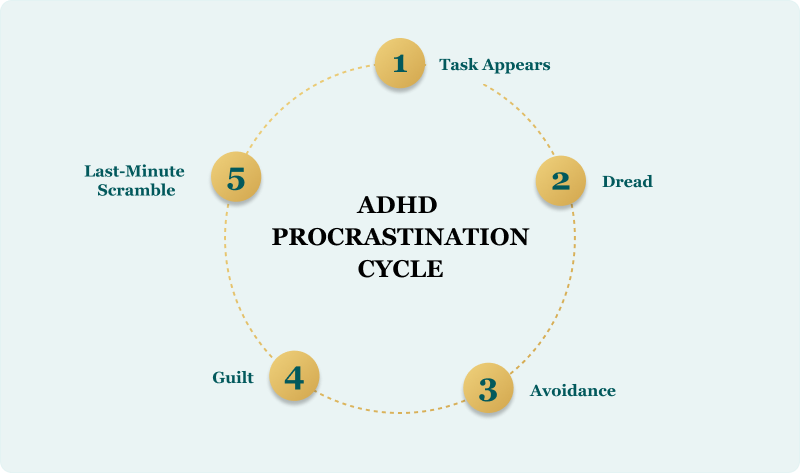
Most productivity advice tries to interrupt this cycle at the "just start" stage. By then, though, the dread and guilt are already running the show. The strategies further down work because they step in earlier, before the cycle has a chance to spin up.
Procrastinating on folding laundry is frustrating. Procrastinating on a work deliverable can feel like it's threatening your entire career.
When you miss a deadline at work, it's rarely just about the missed deadline. It's the assumption that tends to come with it: that you're careless, or uncommitted, or not cut out for the role. That assumption can quietly follow you into performance reviews, into how your manager hands out projects, into whether you're considered for the next promotion.
That gap between how capable you actually are and how unreliable you can look on paper is exhausting to carry. It's also one of the most common things we hear from clients before they start coaching. If this is resonating, we've written more about how executive dysfunction and how to ask for the right accommodations at work.
None of this means you need to work harder. It means you need different tools.
These strategies aren't about forcing motivation. They're about lowering the barrier to starting, so your brain doesn't have to fight itself just to begin.
Tell yourself you only have to do five minutes. Open the document and write one sentence. Reply to the email with just a greeting. The goal isn't to finish, it's to get your brain past the hardest part: starting.
Once you're a few minutes in, momentum usually carries you further than expected. And if it doesn't, you've still moved the task forward instead of leaving it untouched.
"Write the report" is a wall. "Open a blank document" is not. Break the task down until the first step feels almost too small to count. If your brain balks at "clean the kitchen," try "put one dish in the dishwasher." The smaller the entry point, the less resistance you'll feel.
Perfectionism is one of the sneakiest drivers of procrastination, especially for high-achieving professionals. If part of you believes the work has to be excellent, starting feels risky, so you avoid it entirely. Give yourself permission to write a genuinely bad first draft. Send the ugly, unpolished version of that email. A messy first attempt can always be improved. A blank page can't.
Since your internal sense of time isn't always reliable, borrow an external one. Use a visible timer, a countdown clock, or an alarm that forces the passage of time into view. It turns time from something abstract into something you can actually watch happening, which makes it far easier to respect.
Instead of starting from today and hoping you'll get to it in time, start from the deadline and work backward. Map out what needs to happen a week before, three days before, and the day before. That gives you concrete checkpoints along the way, instead of one distant due date that doesn't feel real until it's too late.
Body doubling means working alongside another person, in person or on a video call, even if you're doing completely different tasks. Something about another person's presence makes it easier for an ADHD brain to settle into work. If you haven't tried this yet, we've got a full breakdown of how body doubling works and why it's so effective.
Save a favorite playlist, a good coffee, or a podcast you love for the tasks you dread most, and only let yourself have it while you're working on that task. It gives your brain an immediate reason to start, instead of relying on willpower and a payoff that's still days away.
Tell a friend what you're working on and ask them to check in. Set a coaching session around a specific project. Put your progress somewhere someone else can see it. External accountability doesn't depend on your motivation showing up on cue. It gives you a reason to start that isn't only coming from inside your own head.
You don't have to manage all of this alone. That might mean asking your manager for more frequent check-ins, requesting a clearer breakdown of project expectations, or working with a coach who understands how your brain actually operates. Of everything on this list, this is the one that tends to make the biggest long-term difference. It's the only strategy that builds support into your environment instead of asking you to compensate for everything by yourself.
These strategies genuinely help. But if you've tried things like this before and procrastination is still costing you at work, that's not a sign you didn't try hard enough. It's a sign you might need support built specifically around how your brain works, not a generic system borrowed from someone else's. If procrastination feels less like a habit and more like a wall you physically can't get past, that's also worth mentioning to a doctor. Sometimes the missing piece isn't a strategy at all.
Procrastination isn't a character flaw, and it was never going to be solved by trying harder. It's a mismatch between generic advice and a brain that runs differently. Once you see it that way, you can stop blaming yourself and start building systems that actually fit.
If you're ready for support built around your brain instead of against it, book a strategy call with our team. We coach ADHD professionals through exactly this, every day.

Founder, CEO & Public Speaker
Jess Jarmo is a neurodivergent career coach with over 18 years of experience in recruitment. She holds a degree in Education and an MBA in Human Resources. She specializes in supporting professionals with ADHD, anxiety, dyslexia, and autism in navigating their careers. Drawing from her own lived experience with dyslexia, ADHD, and anxiety, Jess brings practical, real-world insight to her coaching. As a parent of three neurodivergent children, she is committed to helping individuals grow in ways that align with how they think and work.